
Friday Frenzy: The Top Ten 3D Printing Breakthroughs This Week
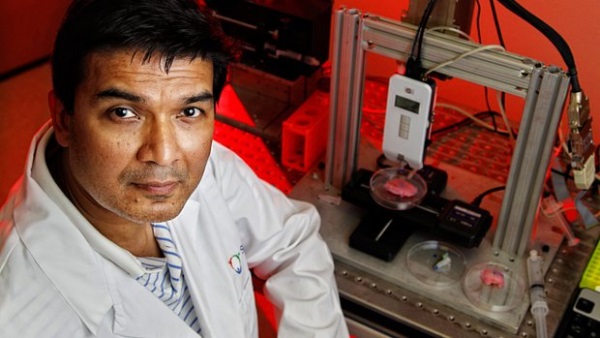
- Biomedical engineers in the United States have announced a unique micro-robotic technique to assemble the components of complex materials, bringing 3D-printed replacement organs even closer to reality.
- Dr. Darryl D’Lima and colleagues at the Scripps Clinic in La Jolla, California are developing new 3D bioprinting technology that will print living cartilage into the body to provide better treatment for patients with knee injuries.
- Researchers at NASA and Stanford University are trying to 3D print cell clusters that can produce non-living structural biomaterials like wood, bone minerals and tooth enamel.
- Utrecht’s experimental tissue factory aims to use research and 3D printing technology to break new ground in biofabrication and bring living, 3D-printed cartilage one step closer to reality.
- A surgeon has helped a man to walk again by 3D-printing him a new pelvis. The patient had half of his original pelvis removed to stop the spread of chondrosarcoma, a rare type of cancer.
- Boston-based startup Mark One recently announced a 3D printer that can print composite materials. DW looks at how car makers are using this technology and its possible effects.
- NASA’s Goddard Space Flight Center has already taken its first additive-manufactured device into space: a battery-mounting plate used for a sounding rocket mission.
- Goddard technologists worked with EOS of America Inc. to develop the first 3D-manufactured object made with invar, a bendable material that’s resistant to shrinkage and expansion due to temperature changes.
- Goddard has developed a system-on-a-chip with a housekeeping function. According to NASA, the “structured, radiation-hardened, application-specific, integrated circuit” consumes less than half a watt of power.
Google+





